This site is intended for US healthcare professionals only.

Prescribing Information

Image
Study Design

Please note: Study 1 primary endpoint did not meet statistical significance. COVID-19 may have been a factor that contributed to missing data in Study 1. 31% of patients (N=38) who had at least 1 post-baseline assessment of HQ-CT (N=124) experienced interrupted visits.1

Scroll to view more


Efficacy was measured by HQ-CT Total Score, the standard for observing hyperphagia in clinical trials8,9

The HQ-CT is a validated, 9-item, caregiver-completed instrument designed for use in clinical studies.8

  • The instrument was designed to assess a range of hyperphagia behaviors during the prior 2 weeks8
  • Each of the 9 items was graded 0 to 4, with Total Score ranging from 0 to 368
  • The instrument was completed consistently by the same caregiver in each study8
  • A lower HQ-CT Total Score indicated less severe hyperphagia

.

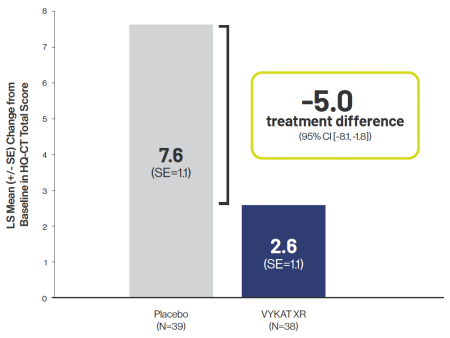
Patients who continued VYKAT XR had less hyperphagia vs placebo at the end of the randomized withdrawal period2

HQ-CT Total Score Change at Week 16
hq-ct-graph

Patients randomized to placebo had statistically significant worsening of hyperphagia vs those who continued taking VYKAT XR

  • Study 2-RWP included 77 patients who completed Study 2-OLE. All patients entering the study had completed 2.5-4.5 years of treatment with VYKAT XR
  • In Study 2-RWP, the mean baseline HQ-CT Total Score for patients taking VYKAT XR vs placebo was 9.0 and 8.1, respectively
  • A lower HQ-CT Total Score indicated less severe hyperphagia

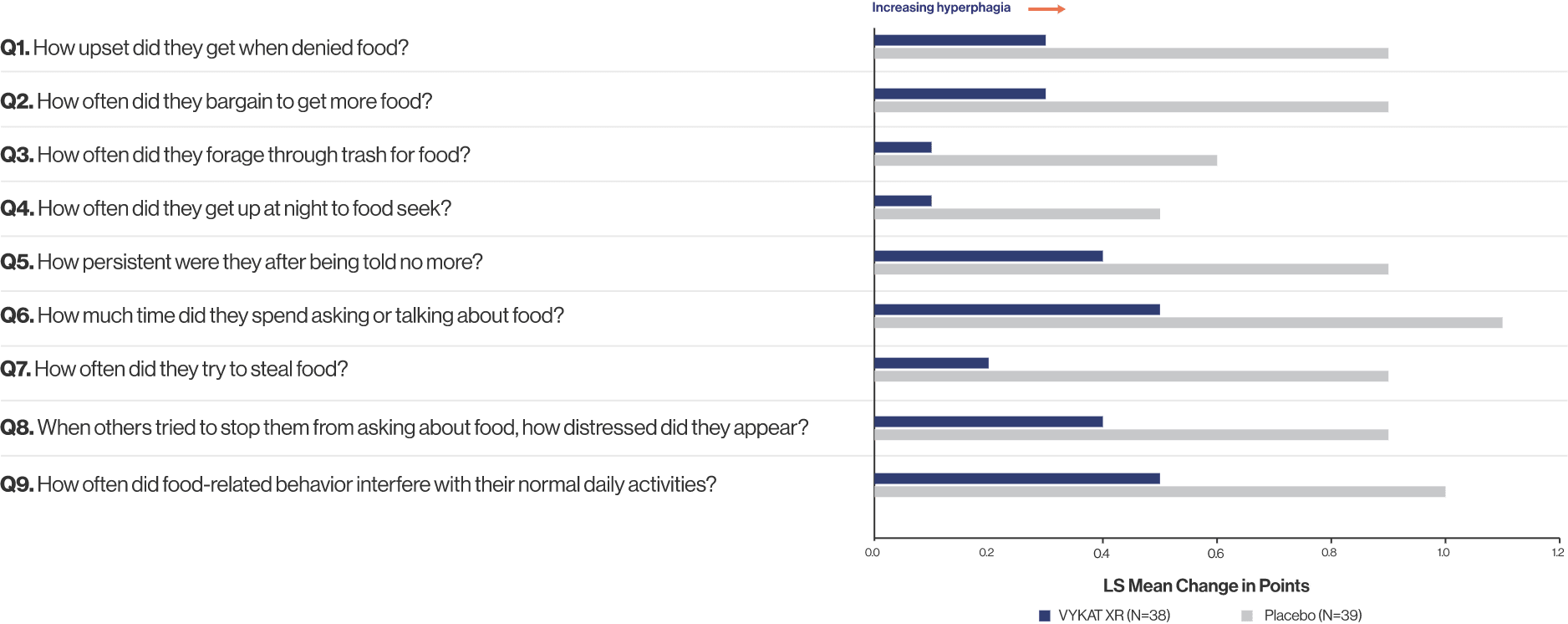
Changes were observed across all questions of the HQ-CT with VYKAT XR vs placebo2,4

HQ-CT item changes from baseline at Week 16 in Study 2-RWP2,4
graph Image

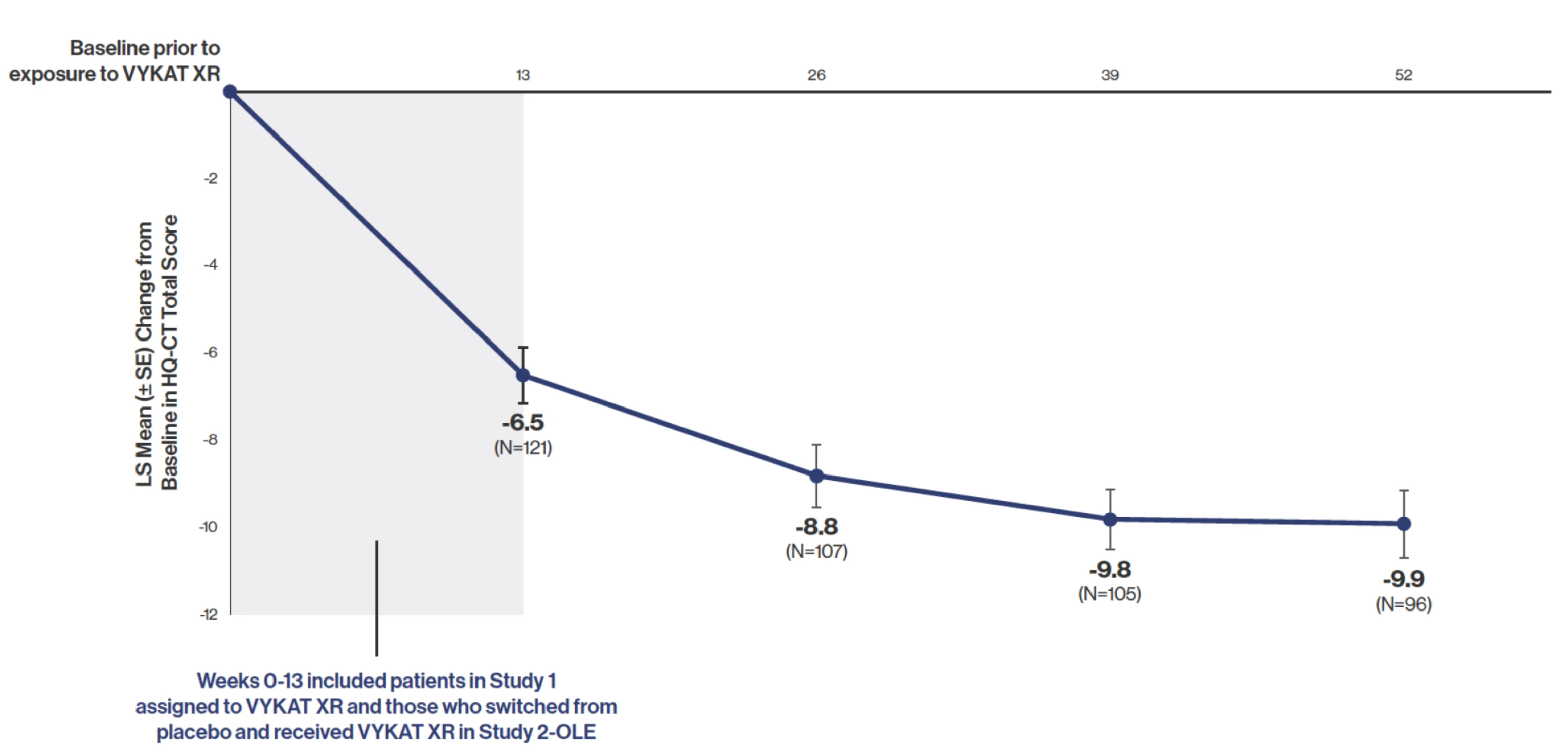
Patients from Study 1 who continued VYKAT XR or switched from placebo had reductions in their Study 2-OLE HQ-CT Total Score3

Weeks of exposure to VYKAT XR (N=125)3
hq-ct-graph
 

Set expectations around when patients can expect to see efficacy with VYKAT XR to ensure adherence at the start and throughout treatment.


It can take time to notice changes in hyperphagia, sometimes over many months.2,4

Helping patients stay consistent with their prescribed VYKAT XR regimens is important.

Patients who continued VYKAT XR had less hyperphagia vs placebo at the end of the randomized withdrawal period2

HQ-CT Total Score Change at Week 16

hq-ct-graph

Patients randomized to placebo had statistically significant worsening of hyperphagia vs those who continued taking VYKAT XR

  • Study 2-RWP included 77 patients who completed Study 2-OLE. All patients entering the study had completed 2.5-4.5 years of treatment with VYKAT XR
  • In Study 2-RWP, the mean baseline HQ-CT Total Score for patients taking VYKAT XR vs placebo was 9.0 and 8.1, respectively
  • A lower HQ-CT Total Score indicated less severe hyperphagia

Changes were observed across all questions of the HQ-CT with VYKAT XR vs placebo2,4

HQ-CT item changes from baseline at Week 16 in Study 2-RWP2,4

graph Image

Patients from Study 1 who continued VYKAT XR or switched from placebo had reductions in their Study 2-OLE HQ-CT Total Score3

Weeks of exposure to VYKAT XR (N=125)3

hq-ct-graph

Scroll to view more


Set expectations around when patients can expect to see efficacy with VYKAT XR to ensure adherence at the start and throughout treatment.


It can take time to notice changes in hyperphagia, sometimes over many months.2,4

Helping patients stay consistent with their prescribed VYKAT XR regimens is important.

Patients taking VYKAT XR should continue with their routines for managing hyperphagia10-12

  • Environmental controls, behavioral management, and nutrition optimization are key to continuous management of hyperphagia11,12
  • VYKAT XR can be taken with the diet plan that works best for your patients

Image
patient-siobhan

Siobhan Avid reader taking VYKAT XR

IMPORTANT SAFETY INFORMATION

Contraindications

Use of VYKAT XR is contraindicated in patients who have a known hypersensitivity to diazoxide, other components of VYKAT XR, or to thiazides.

Warnings and Precautions

Hyperglycemia

Hyperglycemia, including diabetic ketoacidosis, has been reported. Before initiating VYKAT XR, test fasting plasma glucose (FPG) and HbA1c; optimize blood glucose in patients who have hyperglycemia. During treatment, regularly monitor fasting glucose (FPG or fasting blood glucose) and HbA1c. Monitor fasting glucose more frequently during the first few weeks of treatment in patients with risk factors for hyperglycemia.

Risk of Fluid Overload

Edema, including severe reactions associated with fluid overload, has been reported. Monitor for signs or symptoms of edema or fluid overload. VYKAT XR has not been studied in patients with compromised cardiac reserve and should be used with caution in these patients.

Adverse Reactions

The most common adverse reactions (incidence ≥10% and at least 2% greater than placebo) included hypertrichosis, edema, hyperglycemia, and rash.

Drug Interactions

Concomitant use of VYKAT XR with strong CYP1A2 inhibitors increases exposure of diazoxide. Reduce VYKAT XR dosage with strong CYP1A2 inhibitors. Concomitant use of VYKAT XR is not recommended with CYP1A2 substrates due to increased exposure of these substrates. Concomitant use of VYKAT XR is not recommended with dual strong CYP3A4/moderate CYP1A2 inducers due to decreased exposure of VYKAT XR. Diazoxide is highly bound to serum proteins and may displace other drugs that are also highly bound to protein of which impact is expected to be clinically important for narrow therapeutic index drugs; monitor INR with coumarin or its derivatives and monitor diphenylhydantoin serum levels and adjust dose if needed when used concomitantly with VYKAT XR. Concomitant use of VYKAT XR with thiazides or other diuretics may potentiate hyperglycemic and hyperuricemic effects; dose adjustment of VYKAT XR or diuretics may be needed.

To report SUSPECTED ADVERSE REACTIONS, contact Soleno Therapeutics, Inc. at 1-833-765-3661 or the FDA at 1-800-FDA-1088 or www.fda.gov/medwatch.

Please see the full Prescribing Information, including Medication Guide.

INDICATION

VYKAT XR is indicated for the treatment of hyperphagia in adults and pediatric patients 4 years of age and older with Prader-Willi syndrome (PWS).

COVID-19, SARS-CoV-2 2019; HQ-CT, Hyperphagia Questionnaire for Clinical Trials; LS, least squares;
OLE, Open-Label Extension; RWP, randomized withdrawal period; SE, standard error.

*Patients in Study 1 were randomized in a 2-to-1 ratio and patients in Study 2-RWP were randomized in a 1-to-1 ratio.

References:

  1. Miller JL, Gevers E, Bridges N, et al. Diazoxide choline extended-release tablet in people with Prader-Willi syndrome: a double-blind, placebo-controlled trial. J Clin Endocrinol Metab. 2023;108(7):1676-1685.
  2. Data on file, Soleno Therapeutics, Inc.
  3. Miller JL, Gevers E, Bridges N, et al. Diazoxide choline extended-release tablet in people with Prader-Willi syndrome: results from long-term open-label study. Obesity (Silver Spring). 2024;32(2):252-261.
  4. Gevers EF, Miller JL, Bridges NA, et al. Withdrawal of diazoxide choline extended-release (DCCR) tablets worsens hyperphagia and increases weight and BMI in a 16-week, double-blind, placebo-controlled, randomized withdrawal period in patients with Prader-Willi syndrome. Presented at ENDO 2024; June 1-4, 2024; Boston, MA.
  5. A study of diazoxide choline in patients with Prader-Willi syndrome. ClinicalTrials.gov identifier: NCT03440814. Updated September 21, 2023. Accessed December 11, 2025. https://clinicaltrials.gov/study/NCT03440814
  6. Open-label extension study of DCCR in PWS followed by double-blind, placebo-controlled, randomized withdrawal period. ClinicalTrials.gov identifier: NCT03714373. Updated April 19, 2024. Accessed December 11, 2025. https://clinicaltrials.gov/study/NCT03714373
  7. Open-label extension study of DCCR in patients with Prader-Willi syndrome. ClinicalTrials.gov identifier: NCT05701774. Updated April 4, 2024. Accessed December 11, 2025. https://clinicaltrials.gov/study/NCT05701774
  8. Matesevac L, Vrana-Diaz CJ, Bohonowych JE, et al. Analysis of hyperphagia questionnaire for clinical trials (HQ-CT) scores in typically developing individuals and those with Prader-Willi syndrome. Sci Rep. 2023;13:20573.
  9. Fehnel S, Brown M, Nelson L, et al. Development of the hyperphagia questionnaire for use in Prader-Willi syndrome clinical trials. Poster. Presented at ISPOR 20th Annual International Meeting; May 16-20, 2015; Philadelphia, PA.
  10. Heymsfield SB, Avena NM, Baier L, et al. Hyperphagia: current concepts and future directions proceedings of the 2nd international conference on hyperphagia. Obesity (Silver Spring). 2014;22 Suppl 1(0 1):S1-S17
  11. Miller JL, Tan M. Dietary management for adolescents with Prader-Willi syndrome. Adolesc Health Med Ther. 2020;11:113-118.
  12. Ho AY, Dimitropoulos A. Clinical management of behavioral characteristics of Prader-Willi syndrome. Neuropsychiatr Dis Treat. 2010;6:107-118.